Table of Contents
ToggleSuperior Particle Size Reduction (the main colloid mill advantages)
Precision Control Over Fineness
One of the most compelling colloid mill advantages is its ability to achieve controlled particle size reduction. Operators can adjust the rotor-stator clearance to produce coarse dispersions or ultra-fine emulsions.
Precision is not incidental. It is engineered.
This level of control enhances reproducibility across production batches, which is critical in regulated industries such as food processing and pharmaceuticals.
Precise Adjustment Procedure During Shutdown
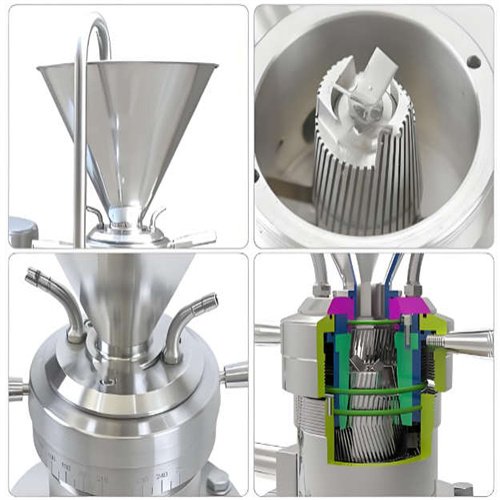
- Loosen the locking device: With the machine off, loosen both handles on the adjustment dial counterclockwise and loosen the limit screw.
- Find the zero position: Rotate the adjustment dial clockwise. Stop immediately when you feel slight resistance; the gap is now “0” (do not start the machine at this point).
- Set the working gap: Remember the zero reading. Rotate the adjustment dial counterclockwise several times (usually at least 180° or according to the scale, 0.01mm per large division) to make the gap slightly greater than 0.
- Tighten and fix: Tighten the locking ring on the handle clockwise and adjust the limit screw to ensure normal machine operation.
Precautions
- Safety warning: Never start the machine when the stator-rotor gap is “0” to avoid damaging the grinding disc or motor.
- Fine-tuning during operation: If adjustment is needed while the machine is running, loosen the handle first, fine-tighten it immediately after fine-tuning, and listen to the machine’s sound to avoid friction. 1. Encyclopedia
- Cleaning and Maintenance: Thorough cleaning is required after use to prevent material residue from adhering and affecting gap adjustment.
Uniform Dispersion and Stability
Uniformity defines product quality. Inconsistent particle distribution can lead to separation, sedimentation, or textural defects, this is another one of colloid mill advantages.
A colloid mill promotes homogeneity by subjecting the material to consistent shear stress throughout the chamber. The outcome is a stable dispersion with reduced phase separation and improved shelf life.
Smooth. Stable. Predictable.
Enhanced Product Texture and Consistency
Texture influences perception. Whether it is a creamy sauce, a cosmetic lotion, or an industrial slurry, consistency determines user satisfaction,third one of colloid mill advantages.
By reducing particle size to micron or sub-micron levels, the colloid mill enhances mouthfeel, spreadability, and flow behavior. Rheological properties become more refined and manageable. The product simply feels better.
Operational Efficiency and Flexibility
High Throughput Capability
Despite its precision, fourth one of colloid mill advantages is not slow. Modern designs support continuous operation with substantial throughput capacity.
This balance between speed and finesse allows manufacturers to maintain productivity without sacrificing quality. It is efficiency without compromise.
Adaptability Across Industries
Few machines demonstrate such cross-industry versatility. Colloid mills are widely used in:
Food processing
Pharmaceutical manufacturing
Chemical production
Cosmetic formulation
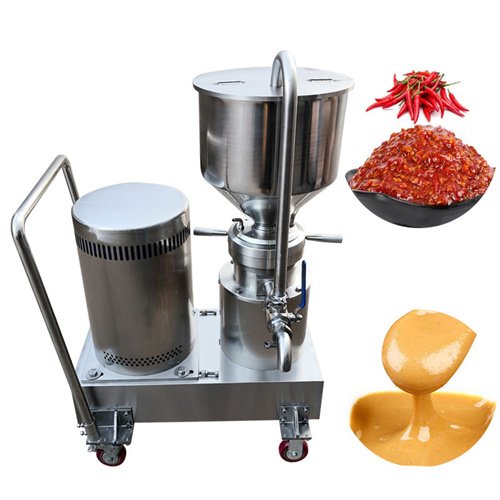
From peanut butter to ointments to specialty coatings, the machine adapts with minimal modification. Its utility is expansive,fifth one of colloid mill advantages.
Continuous Processing Advantages
Continuous processing reduces downtime and enhances operational rhythm. Material flows steadily through the mill, minimizing batch variability and labor intervention.
In large-scale manufacturing environments, continuity translates directly into cost savings and process optimization, these are Colloid mill advantages
.
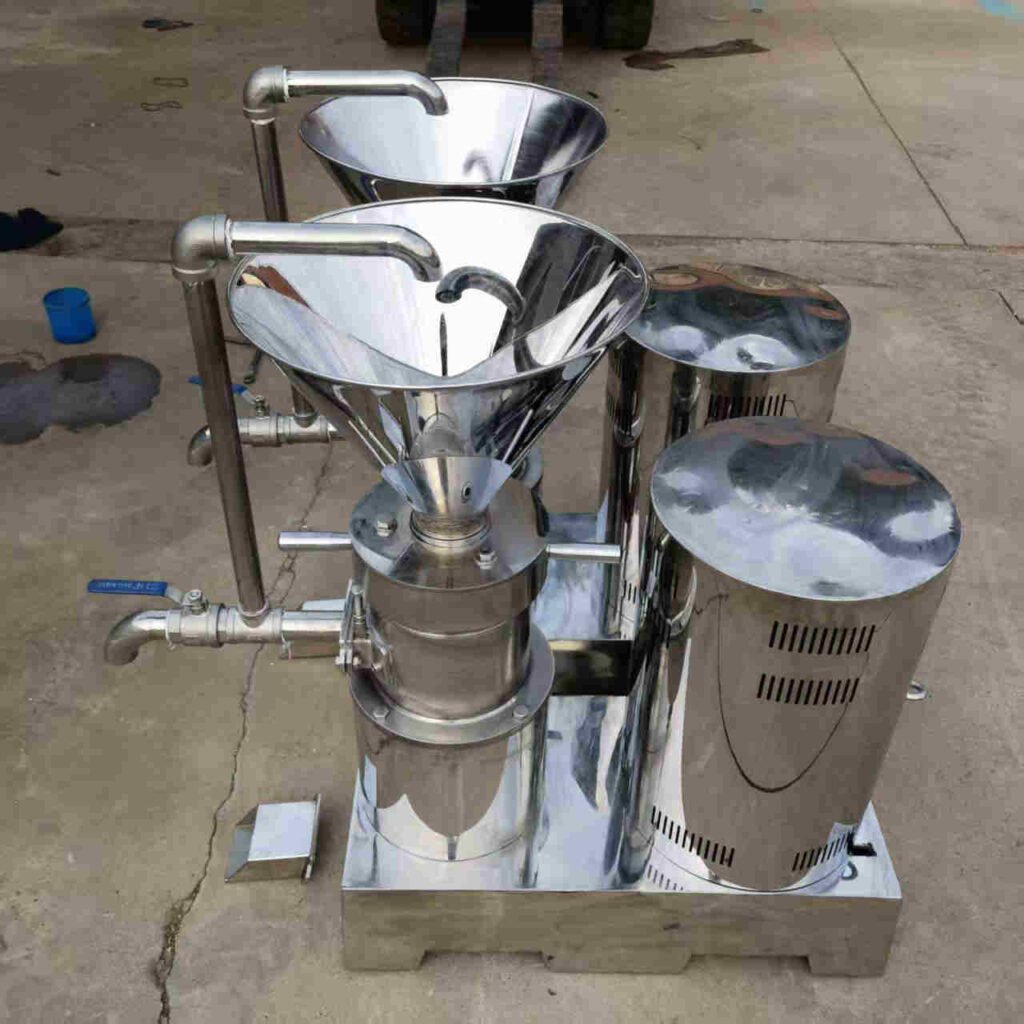
Cost-Effectiveness and Maintenance Benefits
Energy Efficiency in Processing
Colloid mill advantages does not necessarily mean saving energy consumption. The focused mechanical action of a colloid mill ensures that energy is applied directly where it is needed—within the shear zone.
Less wasted motion. More productive output.
Over time, this targeted energy utilization reduces operational expenses.
Simple Maintenance Structure
Maintenance requirements are comparatively straightforward. The rotor and stator components are accessible, and wear parts can be replaced without dismantling the entire system.
Routine inspection and gap calibration typically suffice to maintain optimal performance.
Simplicity enhances reliability.
Long Service Life and Durability
Constructed from corrosion-resistant materials such as stainless steel, colloid mills are built for longevity. With proper maintenance, they deliver sustained performance even under continuous operation.
Durability is not an afterthought. It is intrinsic to the design philosophy.
Quality Improvement and Competitive Edge
Improved Product Appearance
Visual appeal matters. A glossy sauce or silky cream communicates quality before a single word is spoken.
The fine dispersion achieved by a colloid mill eliminates visible granularity, elevating aesthetic standards.
Better Functional Performance
Beyond appearance, functionality improves as well. Enhanced emulsification leads to better absorption in pharmaceuticals, smoother application in cosmetics, and improved stability in chemical suspensions.
Performance becomes consistent and measurable.
Strengthening Brand Reputation
Quality consistency builds trust. Trust builds brand equity.
By integrating a colloid mill into production processes, manufacturers position themselves to deliver superior products with dependable characteristics. In competitive markets, that reliability becomes a strategic advantage.
Core Colloid Mill Advantages
| Advantage | Key Benefit | Ideal Application |
|---|---|---|
| Ultra-fine Particle Size Control | Achieves 1–10 μm particle size with ±2 μm precision via adjustable stator-rotor gap (0.05–1 mm). Ensures uniform texture, no layering, and improved product stability. | Sauces, creams, ointments, paints, and suspensions. |
| High Shear & Homogeneity | Delivers 99%+ homogeneity through high-speed rotor-stator interaction (2880 RPM typical). Creates stable emulsions and dispersions resistant to separation. | Emulsions, cosmetic lotions, pharmaceutical suspensions, and food pastes. |
| Versatile Material Compatibility | Handles liquids, semi-solids, and high-viscosity materials (e.g., pastes, slurries). Works with coarse particles and fibrous materials better than pressure homogenizers. | Food (jams, dairy), pharmaceuticals (ointments, syrups), chemicals (coatings, lubricants). |
| Simple & Robust Design | Compact structure, easy disassembly, and minimal maintenance. Low initial capital cost compared to complex homogenizers. | Small-to-medium production lines and multi-product facilities. |
| Hygienic & Easy to Clean | Food/pharma-grade 316 stainless steel contact parts (no dead zones). Quick disassembly for CIP/SIP cleaning, reducing cross-contamination risks. | GMP-compliant industries (pharmaceuticals, food, cosmetics). |
| Continuous High-Throughput | Enables continuous inline processing for large-scale manufacturing. Balances efficiency and flexibility for batch or continuous operations. | Industrial production of sauces, coatings, and medical creams. |