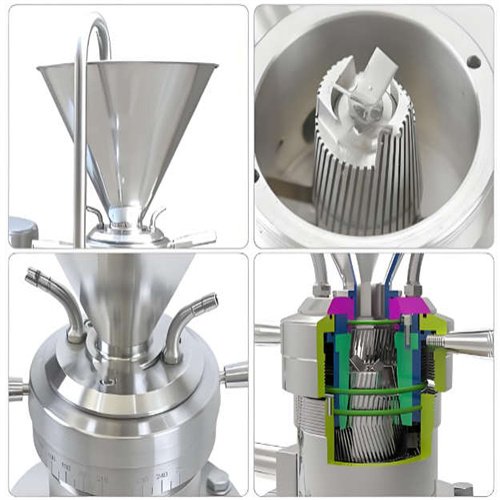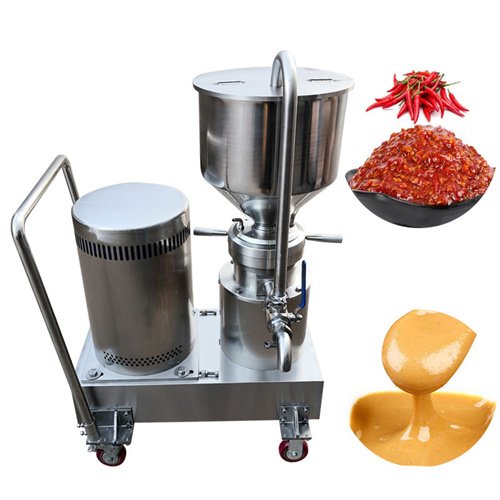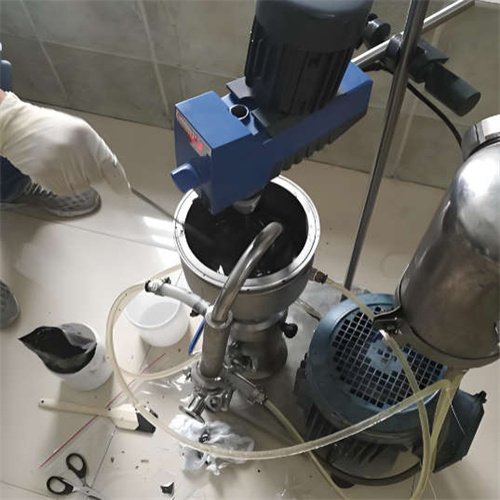
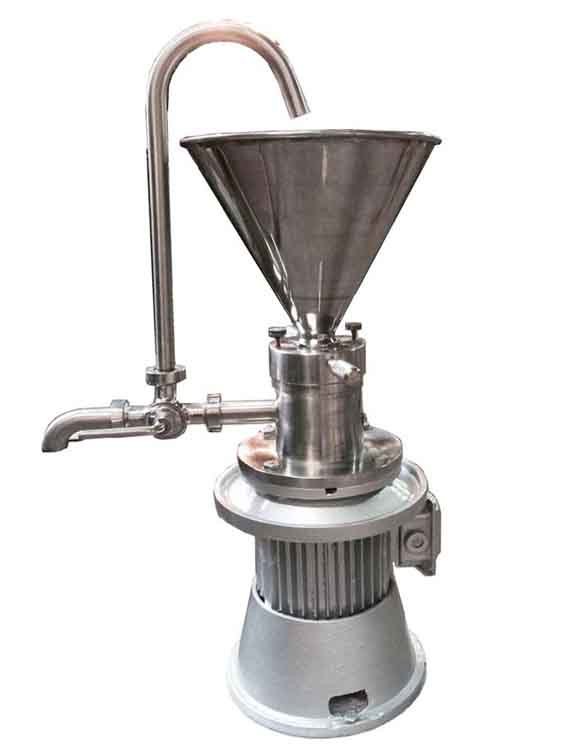
Selecting the right colloid mill for an industrial application is a critical decision that hinges on understanding its core technical specifications. These parameters—Motor Power, Rotational Speed (RPM), and Output Capacity—are not just numbers on a datasheet; they are the fundamental levers that control the machine’s capability, efficiency for your specific process. This comprehensive guide delves into these key specifications, explaining their significance, interrelationships,and how to optimize them for your production needs.
Understanding the Triad of Performance: Power, Speed, and Throughput
The performance of an industrial colloid mill is governed by a dynamic interplay between three primary specifications: the drive motor power , the rotational speed (RPM) of the rotor, and the output capacity or throughput . Misalignment between these factors and your process requirements can lead to inadequate product quality, machine overload, excessive energy consumption, or premature wear.
Drive Motor Power: The Heart of Shear Force
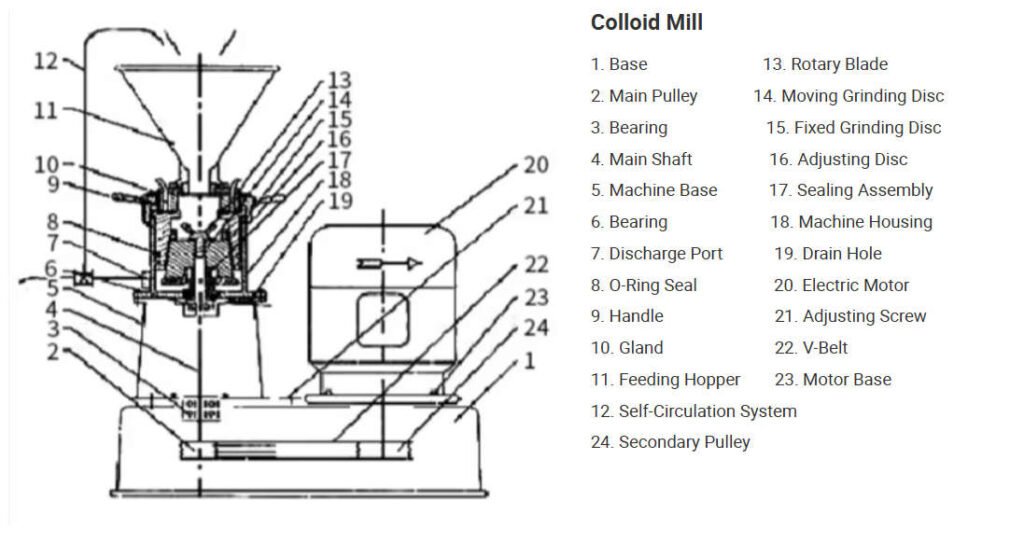
The motor is the powerhouse of the colloid mill. It converts electrical energy into the mechanical energy required to drive the rotor and generate the intense shear forces.
Measuring Motor Power: kW vs. HP
Motor power is typically specified in Kilowatts (kW) or Horsepower (HP) , with 1 HP ≈ 0.746 kW. Industrial colloid mills range from small 1.5 kW (2 HP) laboratory models to heavy-duty machines exceeding 110 kW (150 HP) for large-scale continuous processing.
- Common Power Range: 2.2 kW (3 HP) to 75 kW (100 HP) covers most standard industrial applications.
How Motor Power Affects Performance
- Shear Force & Particle Size: Higher power enables the rotor to maintain speed under load, sustaining the high shear forces necessary to break down tough agglomerates, fibrous materials, or achieve sub-micron emulsions. Under-powered mills will stall or fail to achieve the desired fineness with viscous products.
- Viscosity Handling: Motor power is directly linked to the mill’s ability to process high-viscosity materials. Thick pastes, ointments, and high-solid slurries require significantly more torque, which demands a more powerful motor.
- Throughput Rate: For a given product and target fineness, a higher-powered motor can typically support a greater output capacity (kg/hr or L/hr).
Key Selection Considerations for Motor Power
- Product Viscosity: This is the most critical factor. A rule of thumb: higher viscosity requires higher power.
- Desired Fineness: Achieving a finer particle size or smaller droplet requires more energy input per unit of product.
- Required Throughput: Scaling up batch size or moving to continuous production necessitates more power.
- Rotor-Stator Geometry: A fine-toothed or multi-stage rotor-stator generates more resistance and requires a more robust motor than a smooth or coarse design.
- Duty Cycle: Continuous 24/7 operation requires a motor with a higher service factor and often more conservative power rating than intermittent batch use.
Selection Tip: Always consult with the manufacturer and provide a detailed product sample. It is better to have a slightly over-specified motor running at partial load than an under-powered one struggling at its limit, as the latter leads to overheating, tripped breakers, and poor product quality.
Rotational Speed (RPM): The Engine of Shear Intensity
The rotational speed of the rotor, measured in Revolutions Per Minute (RPM) , is the primary determinant of shear rate and processing intensity.
Understanding Speed Ranges
Industrial colloid mills offer a wide range of operational speeds:
- Standard Speed Range: 2,800 to 4,200 RPM (directly coupled to a 2-pole or 4-pole motor).
- High-Speed Range: 3,000 to 10,000+ RPM, often achieved through belt drives or specialized high-frequency motors.
- Variable Speed Control: Modern mills almost universally feature Variable Frequency Drives (VFDs) , allowing operators to adjust the RPM over a wide range (e.g., 1,000 – 10,000 RPM).
The Critical Role of Tip Speed
While RPM is important, the true measure of shear intensity is the Rotor Tip Speed , calculated as: Tip Speed (m/s) = π × Rotor Diameter (m) × RPM / 60
- Why Tip Speed Matters: It represents the actual linear velocity of the rotor’s edge as it passes the stator. A larger rotor at a lower RPM can achieve the same tip speed as a smaller rotor at a higher RPM. Tip speed directly correlates with the shear stress applied to the product.
- Typical Tip Speeds: Colloid mills typically operate at tip speeds between 20 m/s and 50 m/s . Higher tip speeds (40-50 m/s) are used for ultra-fine emulsions and difficult dispersions.
Impact of RPM on the Milling Process for a colloid mill
- Shear Rate & Fineness: Higher RPM = higher shear rate = smaller resultant particle/droplet size. It is the most direct control parameter for product texture.
- Throughput: Increasing RPM can increase throughput, but only up to a point. Beyond an optimum, excessive speed may cause product degradation, overheating, or inefficient flow patterns.
- Heat Generation: Shear friction is proportional to speed. Higher RPMs generate more heat, making efficient jacket cooling imperative, especially for heat-sensitive products (pharmaceuticals, food).
- Cavitation: At very high speeds, cavitation effects become more pronounced, which can aid in particle breakdown but also increase noise, vibration, and potential component erosion.
The Advantage of Variable Speed Drives (VFDs)
A VFD is no longer a luxury but a standard necessity for process optimization. It allows for:
- Soft Starting: Reduces mechanical stress and inrush current during startup.
- Process Optimization: Fine-tuning speed for different product formulations or stages (e.g., starting at lower RPM for initial mixing, then ramping up for final shearing).
- Versatility: One machine can handle a broader range of products with different viscosity and fineness requirements.
- Energy Savings: Running at an optimal, lower speed for less demanding tasks saves energy.
Output Capacity (Throughput): Defining Production Scale
Output capacity specifies the volume or mass of product a colloid mill can process per unit of time, typically expressed in Liters per Hour (L/hr) or Kilograms per Hour (kg/hr) .
The Myth of a Fixed “Rating”
It is crucial to understand that a colloid mill ‘s stated capacity (e.g., “1000 L/hr”) is not an absolute figure . It is a benchmark under specific, often ideal, conditions. Actual throughput is highly variable and depends on:
- Product Characteristics: Viscosity is the dominant factor. A colloid mill rated for 1000 L/hr of water may only process 200 L/hr of a thick cosmetic cream or 500 L/hr of a medium-viscosity sauce.
- Desired Fineness: Achieving a 5-micron dispersion will require more passes or a slower feed rate than a 20-micron dispersion, drastically reducing effective throughput.
- Process Configuration:
- Single Pass: Higher throughput, but may require a coarser setting.
- Recirculation/Batch Processing: Lower effective throughput as product is cycled multiple times to achieve target fineness and homogeneity.
- Feed System: The efficiency and pressure of the feed pump (if used) or gravity feed setup.
How to Interpret and Specify Capacity
- Ask for a Performance Curve: Reputable manufacturers provide graphs showing throughput (L/hr) vs. product viscosity (cP) for different gap settings.
- Define Your Conditions: When requesting a quote, specify: “We require a throughput of X kg/hr of [Product Name] , with a viscosity of Y cP , to achieve a particle size of Z microns .”
- Consider Upscaling: Choose a colloid mill with a 20-30% higher capacity rating than your current maximum need to accommodate future recipe changes or production increases.
The Interplay with Power and Speed
- Capacity vs. Power: For a given product, to increase throughput, you generally need more motor power to maintain the same shear intensity (RPM/gap) at the higher flow rate.
- Capacity vs. Speed: Increasing RPM can allow for a slightly higher feed rate while maintaining fineness, but it also increases power draw and heat.
Secondary but Critical Specifications
While Power, RPM, and Output are the primary specs, these supporting parameters are essential for a complete evaluation.
Shear Gap Adjustment Range
The minimum distance between the rotor and stator of a colloid mill, adjustable in microns (µm). This is the “final control” for fineness.
- Typical Range: Adjustable from 0.1 mm (100 µm) down to 0.01 mm (10 µm) or even less.
- Importance: A finer gap increases shear but reduces throughput and increases heat and wear. A precise, easy-to-adjust mechanism with a clear scale is vital for repeatability.
Construction Materials & Finish
Defines durability, corrosion resistance, and sanitary compliance.
- Contact Parts: Must be 316L or 304 Stainless Steel , polished to a specific surface finish (e.g., Ra < 0.8 µm for food/pharma) for cleanability.
- Rotor/Stator Wear Parts: Often made from hardened stainless, stellite, or ceramic for extended life, especially with abrasive products.
- Seals: Mechanical seals are standard. For aseptic processing, double mechanical seals with steam barrier or sanitary gland packing are options.
Inlet/Outlet Connections of a colloid mill
Must match your plant’s piping.
- Sizes: Common from 1″ to 4″ sanitary tri-clamp or DIN/ISO flanges.
- Orientation: Can affect layout; vertical colloid mills often have a bottom outlet, horizontal colloid mills a tangential outlet.
Cooling/Heating Jacket Specifications of a colloid mill
- Pressure Rating: Typically 3-6 bar for cooling water or steam.
- Surface Area: A larger jacket area provides better thermal control.
Putting It All Together: A Specification Framework for Buyers
Use this checklist when evaluating or specifying an industrial colloid mill:
A. Process Requirements (Define Your Need):
- Product Name & Type (e.g., Ointment, Sauce, Pigment Slurry)
- Maximum Operating Viscosity (in cP or mPa·s)
- Target Particle/Droplet Size (in microns)
- Required Throughput (kg/hr or L/hr under your conditions)
- Batch or Continuous Process?
- Product Temperature Sensitivity (°C limit)
B. Machine Specifications (Evaluate the Solution):
- Motor Power: ______ kW / HP (Ensure it matches viscosity & throughput)
- Speed Range: ______ to ______ RPM (Variable Speed/VFD is essential)
- Rotor Diameter & Tip Speed: ______ mm, ______ m/s (at max RPM)
- Shear Gap Range: ______ to ______ mm
- Claimed Output Capacity: ______ L/hr (Ask for viscosity reference)
- Construction Materials: Contact Parts ______, Seals ______
- Connections: Inlet ______, Outlet ______, Jacket ______
- Utilities Required: Voltage ______, Cooling Water Flow/PSI ______
Conclusion: Balancing the Specifications for Optimal Performance
Selecting an industrial colloid mill is an exercise in balancing the core triumvirate of Power, Speed, and Output against your specific product characteristics and process goals . There is no universal “best” specification set. A high-viscosity product demands high power. A requirement for nano-scale fineness demands high tip speed (from a combination of RPM and rotor diameter). A large-scale continuous line demands high throughput, which in turn requires both sufficient power and an appropriately sized milling chamber.
By moving beyond catalog ratings and understanding the dynamic relationships between these key specifications, you can make an informed investment. Always engage with technical sales engineers, provide product samples for trials, and prioritize flexibility (e.g., VFDs, adjustable gaps) to ensure your colloid mill remains a valuable and adaptable asset on your production floor for years to come. The right specifications translate directly into product quality, production efficiency, and ultimately, your bottom line.