Table of Contents
ToggleWhen processing emulsions, suspensions, creams, sauces, pharmaceutical products, and other demanding fluids, both colloid mills and high shear homogenizers can provide intense mixing and dispersion. However, they are not interchangeable in every application.
A colloid mill primarily uses a rotor-stator grinding and shearing gap to reduce particle size and produce stable dispersions. A high shear homogenizer uses intense mechanical shear, usually through a rotor-stator system or other specialized homogenizing mechanism, to rapidly break droplets and disperse components throughout a liquid.
Significant Differences in Internal Rotor and Stator Structures
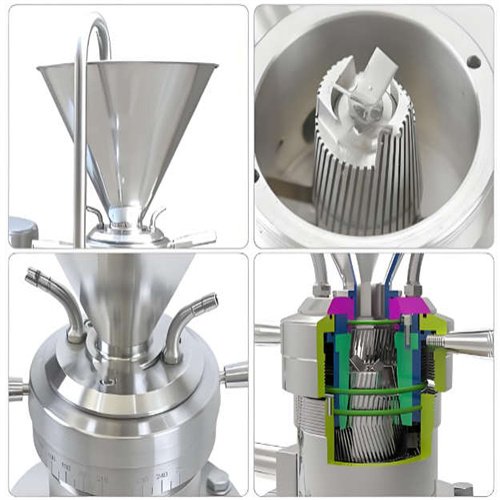
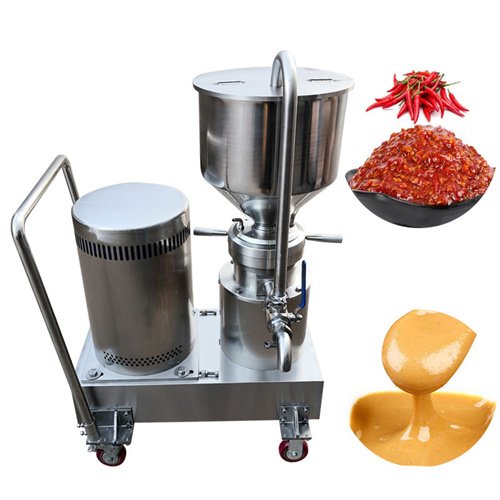
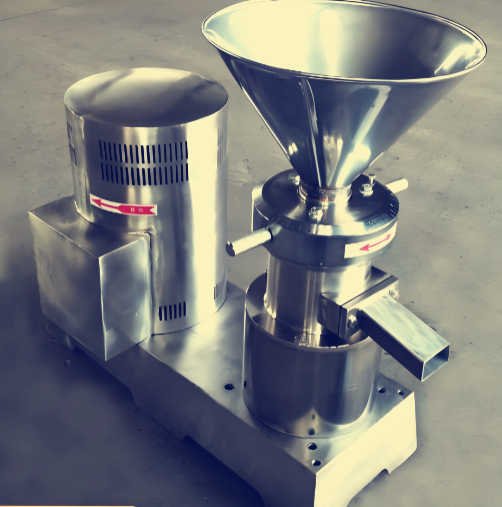
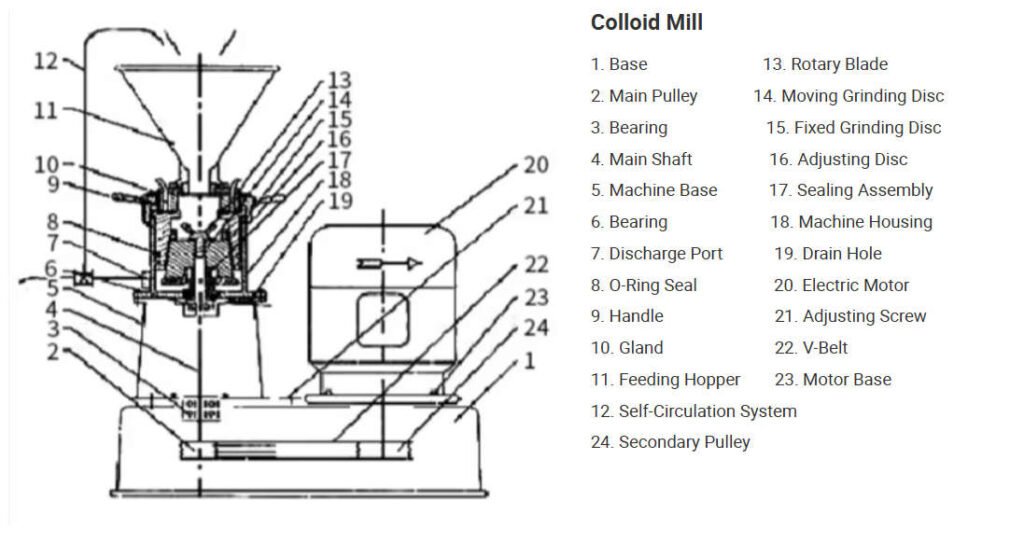
The core working chamber of a colloid mill consists of conical, disc-shaped moving and stationary grinding heads. Its core advantage is precisely adjustable manual gap, with an adjustment range covering 0.05 mm to 1.5 mm, allowing for flexible adaptation to the processing rhythm based on material hardness and particle size. The grinding head surface is covered with densely packed annular oblique tooth grooves, achieving material refinement through layer-by-layer extrusion and kneading. The entire machine is mostly a vertical, split structure, lacking independent conveying thrust and requiring auxiliary feeding equipment at the front end.
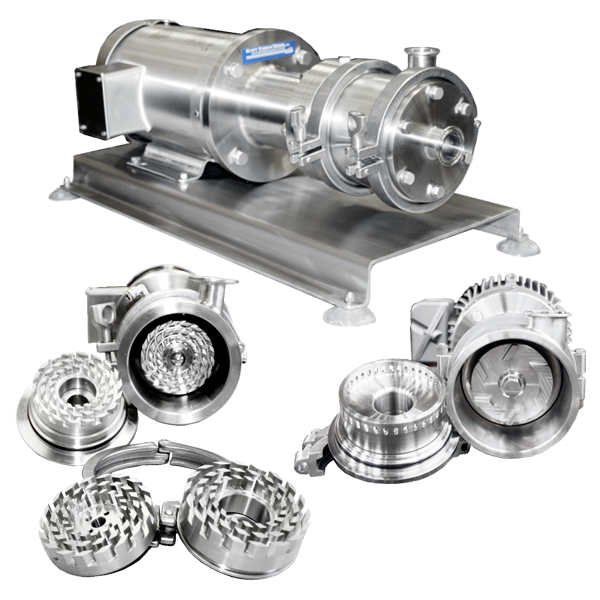
The core working chamber of high shear homogenizer is a straight-through cylindrical rotor-stator integrated structure. The shearing gap is factory-fixed and not adjustable, with a standard range of 0.1 mm to 0.3 mm. Multiple sets of precision shearing tooth grooves are axially connected internally, ensuring continuous flow without any dead zones. The entire machine is standardly equipped with a horizontal integrated structure, featuring a compliant conveying head, and can be directly connected in series to a production line pipeline without the need for additional auxiliary equipment, making it suitable for continuous mass production operations.

Differences in Working Principle, Refining Effect, and Operating Energy Consumption
Different Material Refining Mechanisms
Colloid mills are low-speed, high-torque grinding devices. Material enters the conical grinding chamber by its own weight or auxiliary thrust, passively becoming trapped between the moving and stationary grinding heads. Throughout the process, it endures high-intensity mechanical friction, compression, and low-speed shearing forces, gradually grinding large particles and breaking up material clumps. The overall operation is slow and smooth, without any sudden strong impact forces.
High shear homogenizer are high-speed dynamic shearing devices. The high-speed rotation of the impeller creates negative pressure for automatic material suction. Material enters the precision shearing zone within milliseconds, simultaneously enduring a triple combined force field of high-frequency shearing, strong turbulence, and vacuum cavitation. This instantly tears apart material particles, breaks down the oil-water interfacial tension, and rapidly completes ultra-fine emulsification and dispersion. The refining efficiency is far higher than that of colloid mills, and the operation is continuous and uninterrupted.
Significant Differences in Finished Product Fineness, Temperature Rise, and Energy Consumption
In actual mass production, the particle size range of colloid mill output is stably controlled between 2 and 40 micrometers. The particle size distribution is wide and uniformity is generally low. Frictional heat generation is concentrated during operation, leading to a high temperature rise in the material, which can easily damage the activity of heat-sensitive raw materials. It is suitable for intermittent, small-batch processing.
High shear homogenizer, on the other hand, can output particle sizes from 0.5 to 10 micrometers, with a uniform and concentrated particle size distribution. They exhibit extremely strong emulsification stability, and the finished product does not separate or settle even after prolonged storage. The entire process involves rapid fluid flow and heat exchange, resulting in gentle temperature rise control and effectively protecting the original quality of heat-sensitive materials. In terms of energy consumption, under the same processing capacity, colloid mills have high torque and high ineffective frictional energy consumption, leading to higher overall electricity costs over long-term operation. Emulsifying pumps have high energy conversion efficiency, no redundant mechanical losses, and are suitable for long-term continuous low-consumption production.
Colloid Mill vs High Shear Homogenizer: Key Differences
Although both machines generate high shear, their design objectives and operating characteristics can be different.
| Feature | Colloid Mill | High Shear Homogenizer |
|---|---|---|
| Main function | Grinding, dispersion and emulsification | High-speed mixing, dispersion and emulsification |
| Processing mechanism | Rotor-stator gap with intense shear and grinding | High-speed rotor-stator shear |
| Particle reduction | Very effective | Effective, depending on design |
| Emulsification | Excellent | Excellent |
| High-viscosity products | Generally suitable | Depends on model |
| Paste processing | Very suitable | Depends on configuration |
| Batch operation | Available | Very common |
| Inline operation | Available | Very common |
| Adjustable gap | Common | Depends on design |
| Typical application | Fine grinding and dispersion | Rapid mixing and homogenization |
| Pressure requirement | Usually relatively low | Usually relatively low for rotor-stator types |
| Product circulation | Often recirculation | Batch or inline circulation |
Industrial Application Landscapes
Understanding industry use cases helps clarify where each machine excels:
Applications for Colloid Mills
Colloid mills are chosen when processing heavy, fibrous, or abrasive media that require particle size reduction through friction:
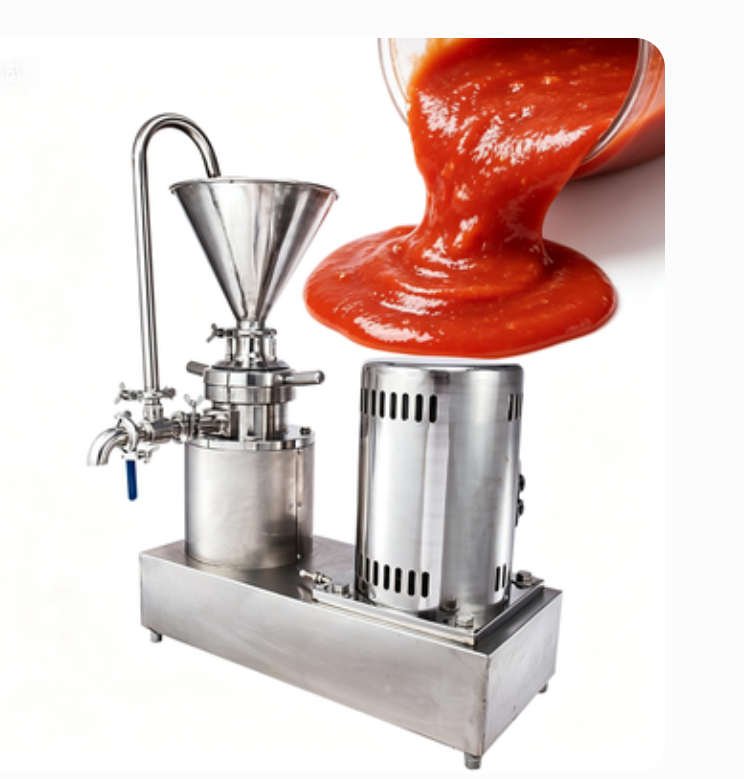
Food Industry: Peanut butter, sesame paste (tahini), mayonnaise grinding, fruit pulp processing, tomato paste, and soy milk production.
Pharmaceuticals: Heavy topical ointments, dental pastes, and coarse medicinal suspensions.
Chemical & Construction: Asphalt emulsions, bitumen modification, grease, pesticide suspensions, and heavy printing inks.
Applications for High Shear Homogenizers
High shear homogenizers are preferred when creating fine emulsions, incorporating light powders, or formulating smooth, uniform liquids:
Cosmetics & Personal Care: Skin creams, lotions, sunscreens, shampoos, hair conditioners, and liquid soaps.
Pharmaceuticals: Sterile syrups, intravenous lipid emulsions, vaccine suspensions, and gel formulations.
Food & Beverage: Salad dressings, flavor emulsions, dairy stabilization, sauce blending, and gum hydration (xanthan, pectin).
Chemicals & Coatings: Pigment dispersions, latex paints, specialty lubricants, and adhesive solutions.
Compatible Materials with Different Viscosities and Feed Particle Sizes
Colloid mills excel in resisting impurities and hard objects, directly processing high-viscosity, high-solids materials. They are suitable for viscosity ranges from 10,000 to 100,000 mPa·s, allowing feed containing large native solid particles up to 5 mm in size. They are specifically suited for complex materials containing coarse fibers, hard powders, and nut fragments.
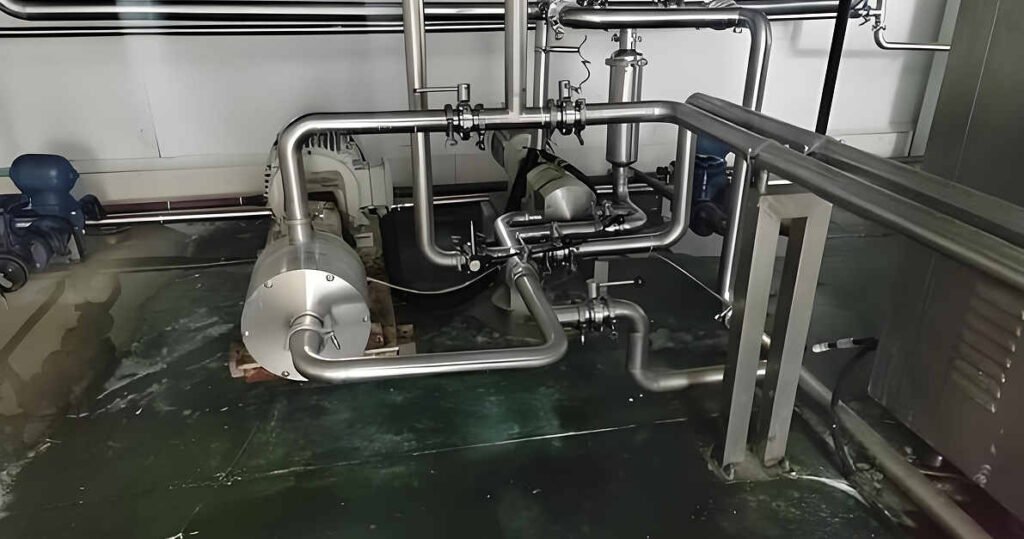
High shear homogenizers have high requirements for feed cleanliness and particle fineness, and are only suitable for low- to medium-viscosity fluids. They are generally suitable for viscosities below 10,000 mPa·s, with feed particle size strictly controlled to within 1 mm. Hard impurities must be strictly prohibited from entering the chamber, otherwise, they will easily wear down the precision rotor and stator. They are suitable for the fine processing of pure, homogeneous fluid raw materials.
How to Choose Between a colloid mill and a high shear homogenizer
When selecting between a colloid mill and a high shear homogenizer, answer these four process questions:
1. Is your primary starting material solid particles or immiscible liquids?
If you need to grind coarse solids, seeds, or fibers in liquid, choose a colloid mill.
If you are blending oil and water phases or dissolving dry powders into liquid, choose a high shear homogenizer.
2. What is the viscosity of your formulation?
For thick pastes, doughs, or high-solids muds, a colloid mill provides the necessary torque and friction handling without clogging.
For pourable liquids, light creams, and aqueous solutions, a high shear homogenizer offers higher flow rates and lower energy consumption.
3. Do you need on-the-fly gap adjustment?
If your process requires frequent adjustment of particle coarseness without swapping internal parts, the colloid mill allows instant gap tuning.
If your product relies on standardized, repeatable shear geometries, the high shear homogenizer with interchangeable stators ensures strict batch-to-batch consistency.