Understanding the Core Principle: It’s All About Shear
The ability of colloid mills to create stable, ultra-fine emulsions, dispersions, and suspensions is various. However, choosing the right mill for your application isn’t a one-size-fits-all decision. The fundamental orientation and design —vertical, horizontal, or inline—can dramatically impact performance, ease of use, and integration into your production line.
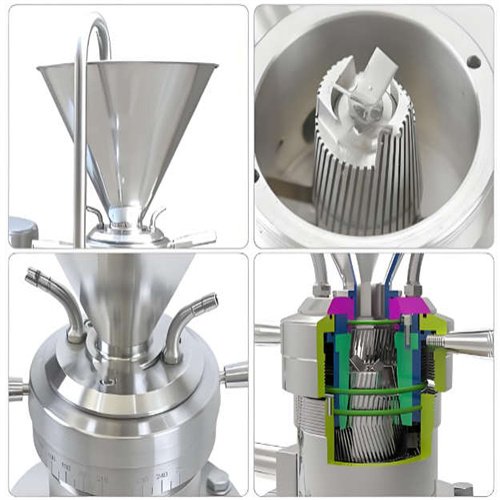
Before diving into orientation, let’s recap how a colloid mill works. Both types operate on the same rotor-stator principle . A high-speed rotor (typically spinning at 3,000 RPM or more) rotates within a closely fitted stator. The microscopic gap between them, often adjustable down to microns, creates intense hydraulic and mechanical shear forces . This action tears apart particles, breaks down droplets, and creates stable, homogeneous emulsions and dispersions.
The critical difference lies in how the product flows through this high-shear zone and how the machine handles it physically.
The Vertical Colloid Mill: The Industry Standard
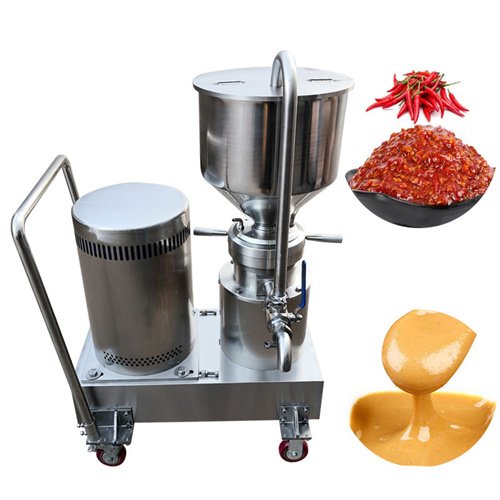
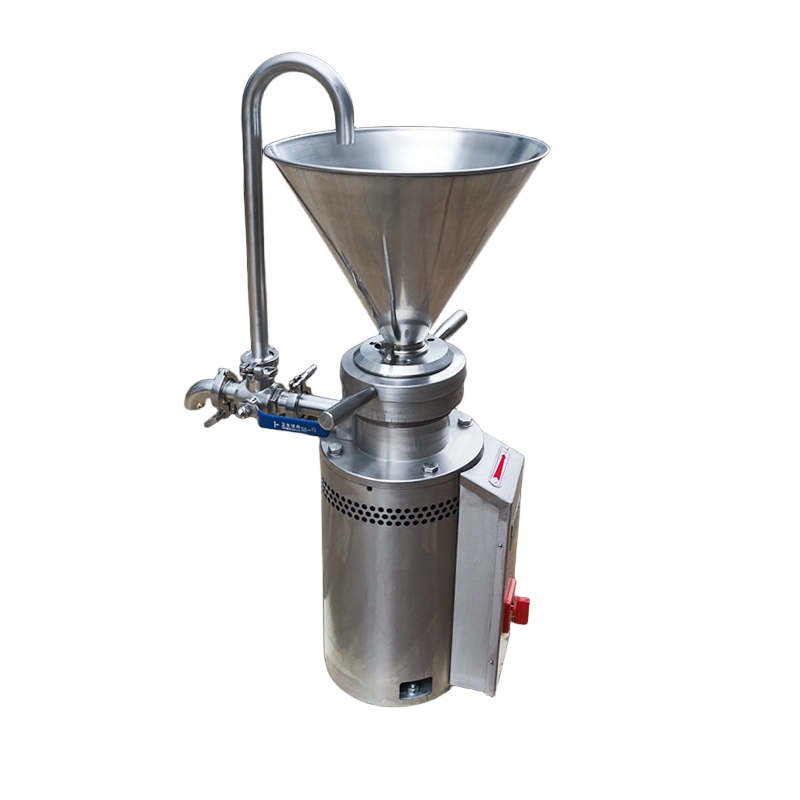
The vertical colloid mill is the most common design. In this configuration, the rotor-stator assembly is mounted on a vertical drive shaft . The product typically enters from the top or side of the grinding head and is forced downward through the shear gap, exiting at the bottom.
Key Advantages of Vertical Colloid Mills
- Gravity-Assisted Flow: For many products, gravity aids in feeding material through the mill, which can simplify processing and reduce the load on feed pumps for certain viscosities.
- Easier Seal Maintenance: The mechanical seal or gland packing is often located above the grinding chamber. This positioning can help prevent the product from penetrating and damaging the seal, and it generally makes inspection and maintenance more accessible.
- Self-Draining Design: Vertical mills can drain more completely after a batch process, minimizing product retention and cross-contamination between batches—a crucial factor in pharmaceutical and food production.
- Compact Footprint: They often have a smaller floor space footprint, making them ideal for facilities with limited space.
Potential Limitations of Vertical Colloid Mills
- Air Entrapment: With certain low-viscosity products, there’s a higher potential for drawing air into the intake, leading to air entrapment in the emulsion, which can be undesirable.
- Feed Pressure Requirements: For thicker, high-viscosity pastes, gravity may not be sufficient, requiring a positive feed pump to push material into the shear zone effectively.
- Height Requirement: The vertical design requires adequate overhead clearance for installation, maintenance, and sometimes for the feeding hopper.
Ideal Applications for Vertical Colloid Mills
- Pharmaceutical creams, ointments, and gels
- Food products like mayonnaise, mustard, and fruit jams
- Cosmetic lotions and liquid soaps
- Lower to medium viscosity chemical dispersions
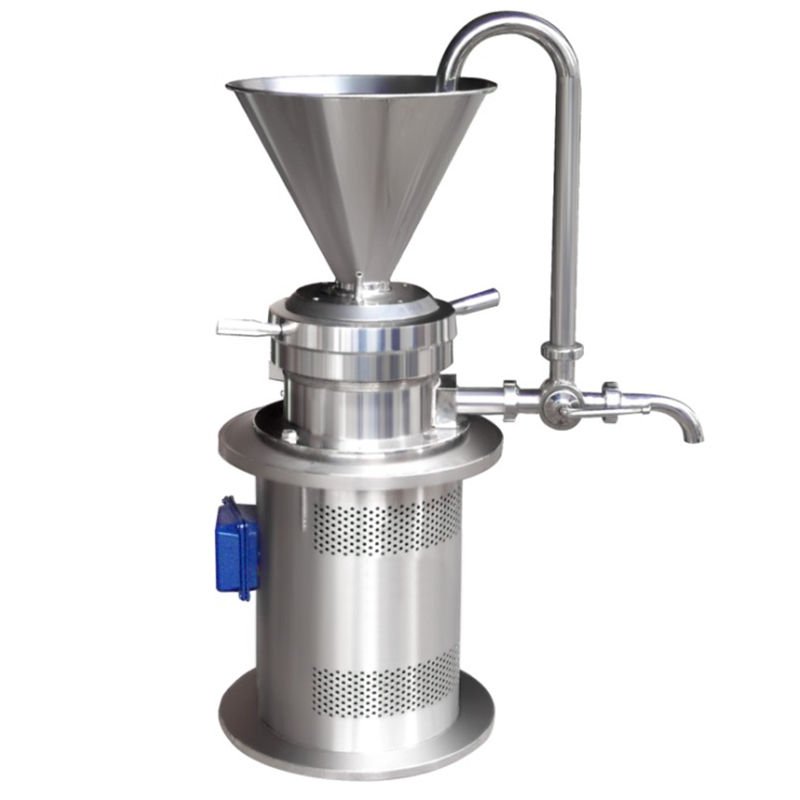
The Horizontal Colloid Mill: The Heavy-Duty Specialist
In a horizontal colloid mill, the rotor-stator assembly is mounted on a horizontal drive shaft . The product flows horizontally through the grinding chamber, entering on one side and discharging from the opposite side.
Key Advantages of Horizontal Colloid Mills
- Superior Handling of Viscous Products: This is their standout feature. The horizontal flow path is exceptionally effective for pumping and processing very high-viscosity materials, pastes, and products with high solid content that might stall or require excessive force in a vertical setup.
- Reduced Air Entrainment: The horizontal inlet and flow design minimize the vortex effect, significantly reducing the chance of drawing air into the product. This is vital for creating dense, void-free emulsions.
- Excellent Filling and Feeding: They are often easier to feed directly from mixers or vessels, especially in continuous in-line production systems.
- Stability for Heavy Loads: The horizontal bearing arrangement can be more robust for handling heavy, abrasive slurries over extended periods.
Potential Limitations of Horizontal Colloid Mills
- Seal Exposure: The shaft seal is in direct contact with the product in the grinding chamber. While modern seals are highly durable, this can make them more susceptible to wear from abrasive products and can complicate maintenance.
- Drainage Challenges: The chamber may not drain as completely as a vertical mill, potentially leading to higher product retention. CIP (Clean-in-Place) systems are often crucial for horizontal designs.
- Larger Floor Space: They typically require more floor space due to their length, though they have a lower height profile.
Ideal Applications for Horizontal Colloid Mills
- High-viscosity paint, pigment, and printing ink dispersions
- Toothpaste and other dense oral care products
- Explosive slurries and heavy chemical compounds
- Nut butters (peanut, almond butter)
- Greases and thick lubricants
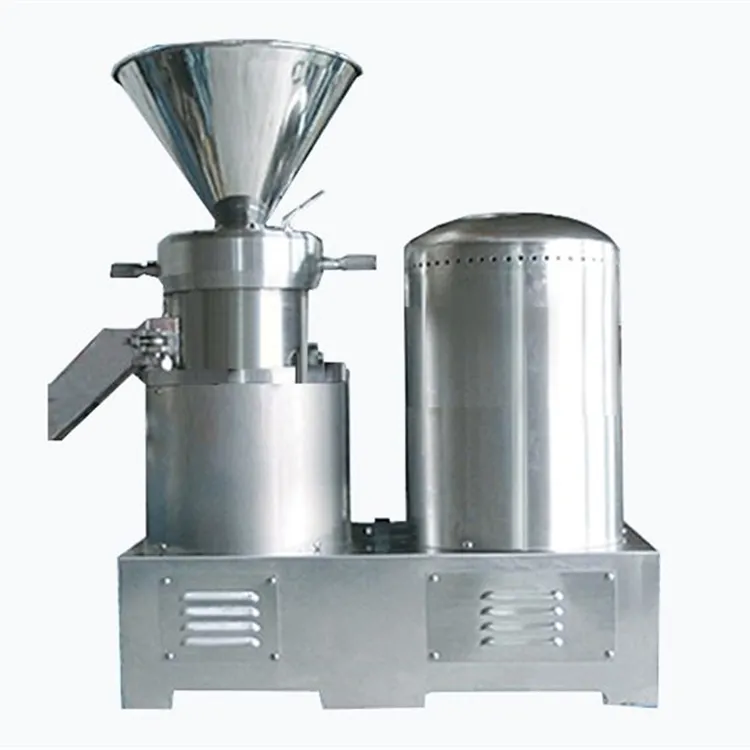
Inline Colloid Mill: The Specialized Integrator
It’s important to clarify terminology. “Inline” is sometimes used to describe the flow path (straight-through) rather than the orientation. Both horizontal and some vertical mills can have in-line configurations. However, in industry parlance, an “Inline Colloid Mill” often refers specifically to a compact, sealed unit designed to be inserted directly into a pipeline , frequently with a horizontal motor but a vertical or angled mill head.
Key Advantages of Inline Mills
- Ultra-Compact & Space-Saving: Designed for maximum integration with minimal footprint.
- Sealed & Sanitary Designs: Many are offered as fully sealed, CIP (Clean-in-Place) capable units, perfect for aseptic processing or handling volatile solvents.
- Minimal Holdup Volume: The product volume inside the mill at any given time is very low, leading to rapid product changeover and minimal waste.
- High-Speed, High-Shear Performance: Often designed for the most demanding emulsification tasks.
Potential Limitations
- Specialized & Potentially Higher Cost: The advanced engineering and materials can come at a premium.
- Limited Access for Maintenance: Servicing often requires returning the unit to the manufacturer or a specialized technician.
- May Require Specific Piping Configurations.
Ideal Applications for Inline Colloid Mills
- High-value, sensitive products in pharmaceutical and biotech industries.
- Sanitary or aseptic processing lines (e.g., injectable emulsions, sterile creams).
- Continuous processes with frequent product changeovers.
- Systems with severe space constraints on the plant floor.
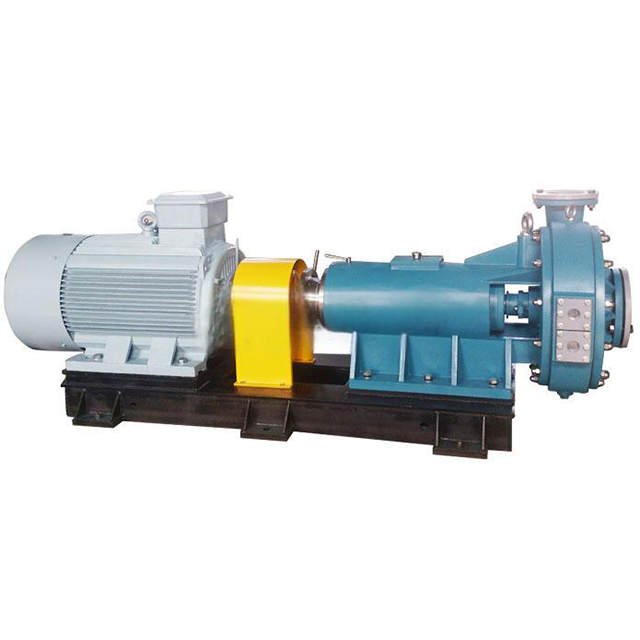
Head-to-Head Comparison: Making the Decision
| FEATURE | VERTICAL COLLOID MILL | HORIZONTAL COLLOID MILL | INLINE (PIPELINE) COLLOID MILL |
|---|---|---|---|
| Primary Strength | Ease of cleaning & maintenance | Pumping ability & pressure generation | Space-saving, sealed integration |
| Flow & Feeding | Gravity-fed hopper or low-pressure feed | Positive pressure, straight-through flow | Direct in-pipeline integration |
| Best For Viscosity | Low to medium | Medium to very high | Low to high (depends on model) |
| Hygiene & Cleaning | Excellent (open, easy access) | Good (may require more disassembly) | Excellent (often full CIP/SIP) |
| Footprint | Small floor, needs height | Longer floor space | Most compact |
| Ideal Process | Batch & semi-batch | Continuous & recirculation | Continuous, sanitary lines |
| Air Entrainment | Potentially higher | Low | Very low |
Final Guidelines: Which Colloid Mill is Best for You?
Ask yourself these critical questions to guide your selection:
1. What is my primary process: Batch or Continuous?
- Batch/R&D: A Vertical Colloid Mill is often the most flexible and user-friendly choice.
- Continuous Line: A Horizontal Colloid Mill is typically the robust, standard workhorse.
- Continuous, Sanitary, Space-Limited: An Inline Colloid Mill is the specialized solution.
2. What is the viscosity of my product?
- Low to Medium (e.g., sauces, creams): All types can work. Choose based on other factors.
- High to Very High (e.g., pastes, putties): A Horizontal Mill is strongly recommended for its pumping capability.
3. How critical is ease of cleaning and maintenance?
- Top Priority (e.g., diverse food batches): The Vertical Mill’s quick-disassembly design is a significant advantage.
- Sealed, CIP Systems (e.g., pharmaceuticals): A modern Inline Mill is built for this purpose.
4. What are my space constraints?
- Limited Floor Space: Consider a Vertical or Inline mill.
- Limited Height: A Horizontal or Inline mill is preferable.
5. Do I need strong pumping action for recirculation or downstream pressure?
- Yes: A Horizontal Colloid Mill is explicitly designed for this duty.
Conclusion: Which is Best for You?
There is no single “best” colloid mill—only the best one for your specific application, product, and process layout .
- Choose the Vertical Colloid Mill for its simplicity, cleanability, and batch-processing prowess.
- Choose the Horizontal Colloid Mill for its power, pumping strength, and continuous line performance.
- Choose the Inline Colloid Mill for advanced, space-efficient, and hygienic integrated processing.