Table of Contents
ToggleI. Food Industry Applications
1. Nut Butters and Spreads
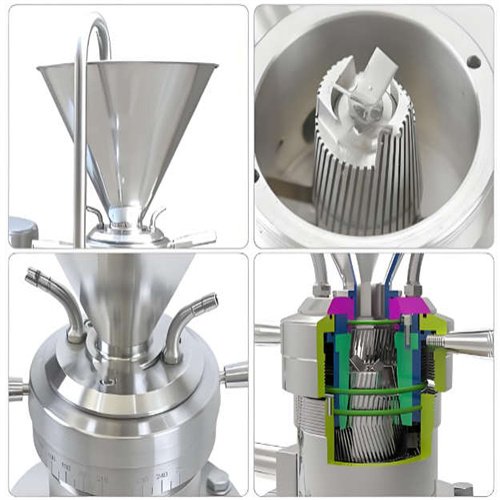
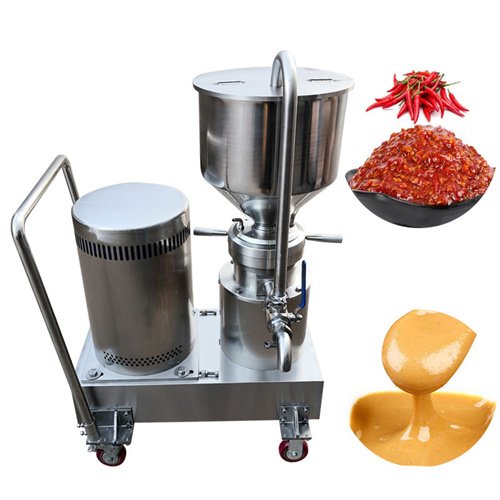
Few processes are as demanding as turning roasted nuts into velvety butter. ,it is one of normal colloid mill applications.The transformation requires intense shear, controlled heat, and impeccable consistency. A Colloid Mill performs this task with remarkable efficiency.
As the rotor and stator of colloid mill generate mechanical turbulence, particle size diminishes progressively. The result is a smooth, cohesive matrix where oil and solids coexist harmoniously. Texture matters. Mouthfeel matters even more.
Without proper milling, spreads become gritty or prone to oil separation. With precise control, they achieve that luxurious, spoonable uniformity consumers expect.
2. Sauces, Dressings, and Condiments
Emulsification is both science and art. Mayonnaise, salad dressings, and specialty sauces depend on stable dispersion between immiscible phases. Oil and water resist each other. Shear persuades them to cooperate.
High-speed mechanical action fractures droplets into micron-scale particles, enhancing stability and preventing phase separation. Short bursts of processing can radically alter viscosity and gloss.
Consistency is everything. A well-milled sauce clings to food with confidence. It pours smoothly. It looks refined.
3. Plant-Based Beverages and Purees
In the evolving landscape of plant-based foods, texture and homogeneity define product success. Almond beverages, soy formulations, and vegetable purees require fine particle reduction to prevent sedimentation.
A colloid mill enhances suspension stability by reducing particle size and increasing surface area interaction. The beverage becomes more stable, less prone to stratification.
Smoothness is subtle. But consumers notice.
II. Pharmaceutical and Cosmetic Uses
1. Ointments and Topical Creams
Topical formulations demand microscopic precision. Active ingredients must be uniformly dispersed to ensure consistent therapeutic effect.
Through controlled shear fields, a colloid mill reduces agglomerates and creates homogeneous matrices. The finished ointment spreads evenly and absorbs predictably.
There is no room for inconsistency in pharmaceutical compounding. Uniformity safeguards efficacy.
2. Suspensions and Liquid Formulations
Many pharmaceutical suspensions contain insoluble particles. Without adequate size reduction, these particles settle rapidly, compromising dosage accuracy.
Fine milling improves dispersion and extends stability. It reduces sedimentation velocity and enhances bioavailability.
The difference between coarse and finely milled particles is not merely visual. It influences pharmacokinetics and shelf life.
3. Lotions and Personal Care Emulsions
In cosmetics, sensory experience defines quality. Consumers expect creams that glide effortlessly and lotions that feel silky rather than heavy.
High-shear milling refines droplet size distribution, improving emulsion stability and tactile elegance. The product becomes more luminous, more cohesive.
Texture communicates quality before performance does.
III. Chemical and Industrial Processing
1. Paints and Coatings
Pigment dispersion is critical in coatings. Uneven particle distribution results in poor coverage, inconsistent color, and reduced durability.
A colloid mill subjects pigments to intense mechanical forces, breaking down aggregates and promoting uniform suspension. The coating becomes smoother and more resilient.
Color depth improves. Surface finish elevates.
2. Lubricants and Greases
In lubricating systems, particle consistency influences frictional behavior and wear resistance. Greases often contain thickeners and additives that require even dispersion.
Through controlled milling, additives integrate seamlessly into the base medium. The final product demonstrates improved stability and enhanced tribological performance.
Small mechanical refinements can extend machinery lifespan significantly.
3. Specialty Chemicals and Slurries
From agrochemicals to advanced material slurries, industrial formulations demand reliable homogenization. High-viscosity compounds challenge conventional mixers.
A colloid mill manages dense, complex systems with relative ease. Its high-energy shear environment promotes uniformity in even the most recalcitrant mixtures.
Consistency fosters predictability. Predictability drives industrial success.
Final Thoughts
Colloid mill applications span food production, pharmaceuticals, cosmetics, and heavy industry. The common denominator is precision. Controlled shear. Reliable dispersion.
Whether refining a gourmet spread or stabilizing a chemical slurry, the principle remains constant: reduce particle size, enhance uniformity, and maintain stability.
In modern processing environments, efficiency and consistency are not optional. They are expected. And the colloid mill delivers both.
Quote: