Table of Contents
ToggleI. Understanding the Core of Colloid Mill Performance
1. The Rotor–Stator Relationship
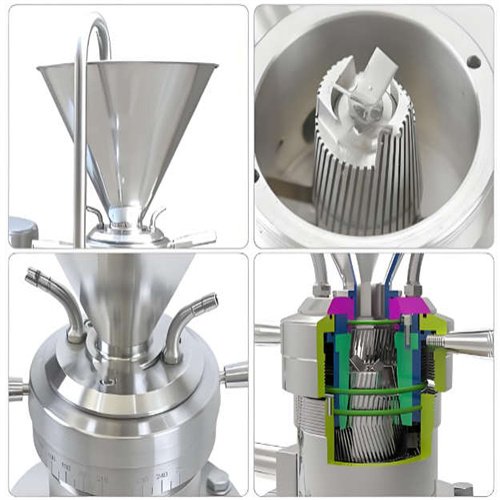
At the heart of every Colloid Mill lies the rotor–stator assembly. This is where the magic happens. The rotor spins at high velocity, while the stator remains fixed, creating an intense mechanical interaction that fractures particles and disperses phases.
Performance begins here. A precisely aligned rotor and stator generate uniform shear fields. Even slight misalignment can introduce vibration, uneven wear, and inconsistent output. Over time, microscopic irregularities widen the working gap, diminishing shear intensity and reducing homogenization quality.
Think of it as choreography. When both components move in perfect harmony, the result is controlled turbulence and exceptional emulsification.
2. Shear Force and Particle Size Control
Shear force is not just a technical term. It is the defining characteristic of a colloid mill’s capability. High shear reduces particle size, enhances dispersion, and stabilizes emulsions. But too much shear can be counterproductive, particularly with temperature-sensitive formulations.
Particle size reduction follows a predictable trajectory when parameters are stable. However, fluctuating feed composition or inconsistent rotational speed can produce heterogeneity. That means grainy textures, phase separation, or unstable suspensions.
Fine-tuning shear intensity requires balance. It is not about maximum speed. It is about optimal velocity under controlled conditions.
3. Temperature and Viscosity Dynamics
Heat is an inevitable byproduct of friction. And friction is intrinsic to high-shear processing. As temperature rises, viscosity often decreases, altering flow behavior inside the milling chamber.
This can be beneficial. Or disastrous.
Thermal escalation may compromise product integrity, especially in food, cosmetic, or pharmaceutical applications. Excess heat can degrade proteins, volatilize aromatic compounds, or destabilize emulsifiers.
Monitoring temperature in real time is not optional. It is fundamental. Cooling jackets, intermittent operation, and controlled feed rates can mitigate thermal buildup and preserve product fidelity.
II.Practical Optimization Techniques
1. Correct Gap Adjustment and Calibration
Gap setting determines shear intensity. A narrower gap amplifies mechanical stress. A wider gap reduces it. Simple in theory, nuanced in practice.
Calibration should be performed systematically. Start with manufacturer-recommended settings, then refine based on product rheology and target particle size. Avoid aggressive tightening without validation. Metal-to-metal contact can cause catastrophic wear.
Small adjustments produce significant effects. Precision matters.
2. Feed Rate and Flow Consistency
A colloid mill thrives on consistency. Erratic feed rates create pressure fluctuations, uneven residence time, and inconsistent particle reduction.
Maintain a steady, metered flow. Use a positive displacement pump when necessary to stabilize input. Avoid surges. Avoid starvation.
Flow behavior influences internal hydrodynamics. Laminar streams behave differently from turbulent ones. Understanding this interplay improves reproducibility and enhances output quality.
3. Preventing Cavitation and Air Entrapment
Cavitation is subtle at first. A faint crackling sound. A slight vibration. Then erosion begins.
Air pockets collapse under pressure, generating micro-shockwaves that pit metal surfaces. This reduces equipment lifespan and compromises efficiency.
Preventing cavitation requires proper inlet pressure, airtight connections, and correct pump sizing. Deaeration prior to milling can further stabilize processing conditions.
Silence is often a good sign. Stable operation sounds smooth, almost meditative.
III. Maintenance Strategies for Long-Term Efficiency
1. Routine Inspection and Wear Monitoring
Wear is gradual. Almost imperceptible. Yet it accumulates.
Regular inspection of the rotor, stator, seals, and bearings prevents performance drift. Measure gap tolerances. Examine surface finishes. Look for scoring or microfractures.
Documentation is powerful. Tracking wear patterns over time allows predictive maintenance rather than reactive repair.
2. Proper Cleaning Protocols
Residue buildup alters flow dynamics and reduces hygienic integrity. Especially in sanitary applications.
Cleaning protocols should align with product characteristics. Viscous or adhesive formulations require thorough flushing. In many industries, clean-in-place systems ensure repeatable sanitation without full disassembly.
Avoid abrasive cleaning tools. Preserve surface integrity. A smooth surface reduces product adherence and simplifies future cleaning cycles.
3. Component Replacement and Preventive Scheduling
Every mechanical system has a lifecycle. Planning replacements before failure prevents downtime and protects product quality.
Seals harden. Bearings fatigue. Rotor edges dull. Proactive scheduling reduces emergency stoppages and preserves throughput efficiency.
A well-maintained colloid mill does not merely function. It performs. Consistently. Reliably. With precision.
Final Thoughts
Optimizing colloid mill performance is not about a single adjustment. It is a systematic discipline that blends mechanical precision, process awareness, and preventive care.
Small refinements compound over time. Better alignment. Steadier flow. Controlled temperature. Structured maintenance.
The result is smoother emulsions, finer dispersions, and longer equipment life.
Performance is never accidental. It is engineered.