In modern industrial processing, achieving uniform mixing, efficient heat transfer, and homogeneous chemical reactions across massive fluid volumes requires specialized equipment. Whether dissolving dry powders, keeping solids suspended in liquid, conventional mixing methods are insufficient for industrial-scale tanks.
This is where the industrial agitator becomes indispensable. Acting as the heart of mixing vessels and reactors, an industrial agitator delivers controlled mechanical energy to keep fluids moving, prevent phase separation, and optimize process efficiency.
From food and beverage production and pharmaceutical synthesis to wastewater treatment and chemical manufacturing, industrial agitators are foundational assets.
What Is an Industrial Agitator?
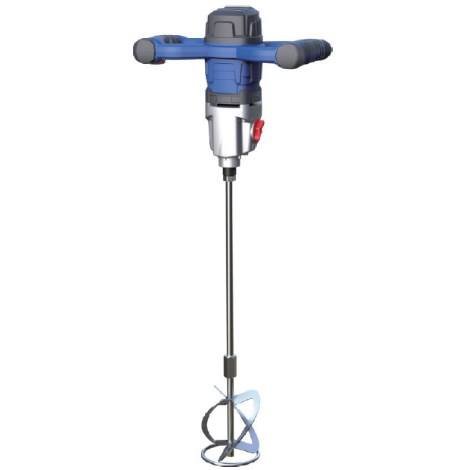
An industrial agitator is a mechanical mixing system installed inside a tank or vessel. It normally consists of a motor, gearbox or speed reducer, drive shaft, impeller, mechanical seal, and mounting structure.
When the motor rotates the shaft, the impeller transfers mechanical energy to the liquid. This creates fluid movement inside the tank and promotes mixing.
Depending on the impeller design and process requirements, an agitator can generate:
- Axial flow
- Radial flow
- Tangential flow
- Turbulent flow
- Low-shear circulation
- High-shear mixing

Working Principle of an Industrial Agitator
The operation of an industrial agitator relies on generating specific fluid dynamics inside a mixing tank.
[ Motor / Gearbox ] ──► [ Shaft Drive ] ──► [ Rotating Impeller ] ──► [ Axial / Radial Fluid Flow ]
The working principle of an industrial agitator is relatively simple.
First, an electric motor provides rotational power. The motor may be connected directly to the shaft or connected through a gearbox when lower rotational speed and higher torque are required.
The rotating shaft transfers power to the impeller. As the impeller rotates, it generates fluid movement inside the tank.
This movement causes different parts of the liquid to circulate and interact with each other.
For example, an agitator may be used to:
- Blend two or more liquids.
- Keep solid particles suspended.
- Prevent sedimentation.
- Improve heat transfer.
- Maintain uniform temperature.
- Disperse powders into liquids.
- Maintain a consistent concentration.
- Promote chemical reactions.
The actual mixing mechanism depends heavily on the impeller design, rotational speed, tank geometry, and fluid properties.
Key Types of Industrial Agitators
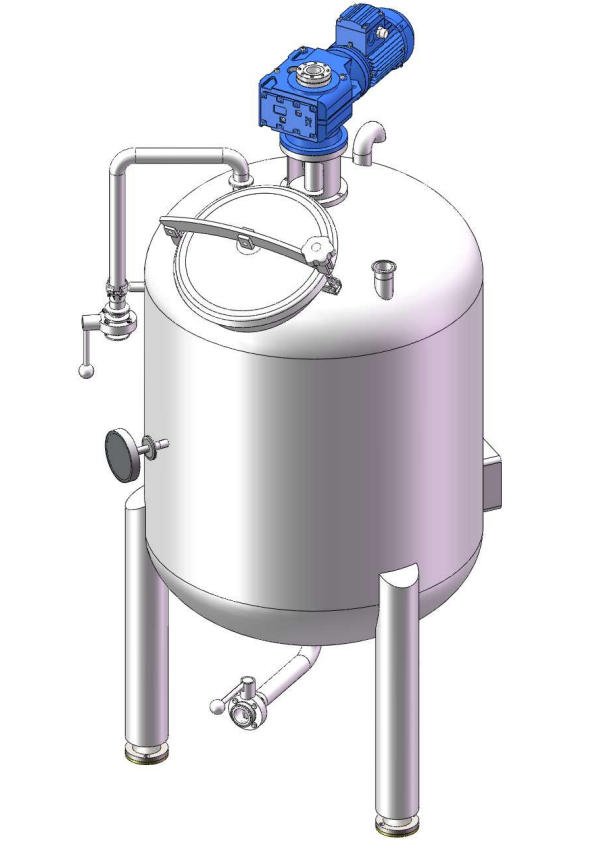
1. Top-Entry Agitators
The drive motor and gearbox are mounted on top of the tank, with the shaft extending downward into the liquid.
- Advantages: Most common design; easy access for maintenance; accommodates long shafts and large impeller diameters; seal is above the liquid level.
- Best For: Large storage tanks, chemical reactors, and heavy slurry suspension.
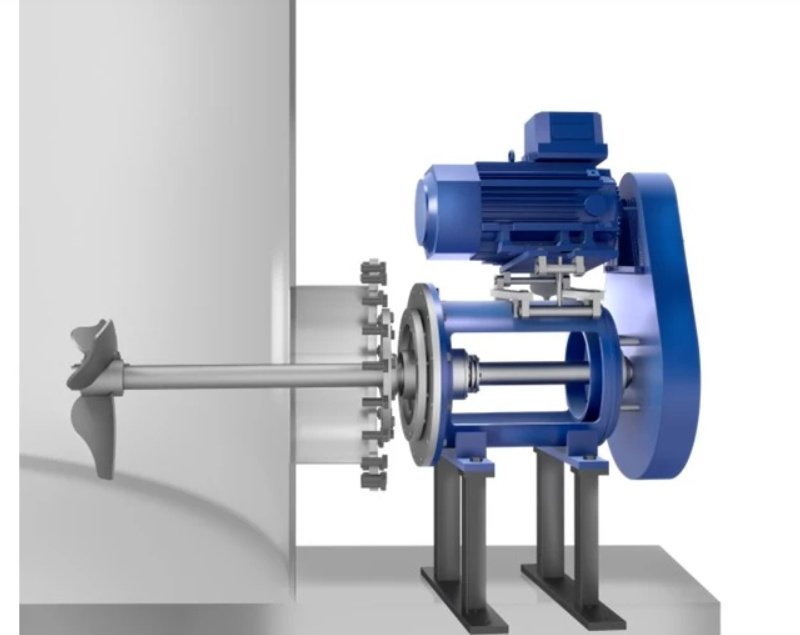
2. Side-Entry Agitators
Mounted horizontally through the lower side wall of the tank.
- Advantages: Ideal for very tall or large-diameter storage tanks where a top-mounted shaft would be impractically long; lower initial capital cost.
- Best For: Crude oil storage, paper pulp tanks, and large wine or beverage blending vats.
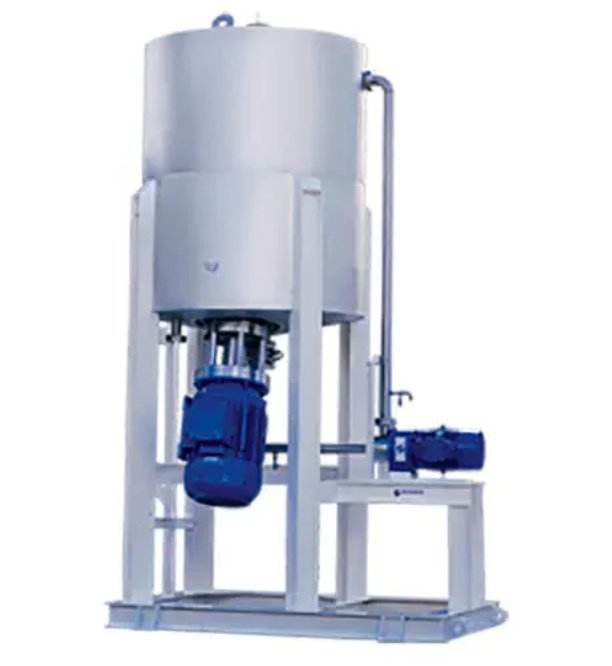
3. Bottom-Entry Agitators
Mounted through the bottom head of the vessel.
- Advantages: Leaves the top of the vessel completely clear for piping and access hatches; ideal for short, wide vessels.
- Best For: High-purity pharmaceutical vessels, magnetic drive applications, and bottom-draining hygienic tanks.
Common Agitator Impeller Types and Their Uses
Selecting the correct impeller geometry is crucial to achieving desired mixing results without wasting energy:
| Impeller Type | Flow Pattern | Viscosity Range | Primary Application |
| Hydrofoil Blade | Axial | Low (1 – 2,000 cPs) | High-efficiency liquid blending and solid suspension |
| Pitch Blade Turbine (PBT) | Mixed (Axial + Radial) | Low to Medium | Heat transfer, general blending, and mild shear |
| Rushton Turbine | Radial | Low to Medium | Gas-liquid dispersion (fermentation) and mass transfer |
| Anchor Impeller | Radial / Close-Clearance | High (10,000 – 100,000 cPs) | Laminar flow, high-viscosity wall wiping, and heat exchange |
| Helical Ribbon | Axial / Close-Clearance | Very High (100,000+ cPs) | Heavy pastes, polymers, creams, and non-Newtonian gels |

Industrial Applications of an Industrial Agitator
1. Chemical Processing
Used in polymerization reactors, neutralization tanks, and crystallization processes requiring precise temperature control and uniform reactant distribution.
2. Food & Beverage
Crucial for cooking sauces, suspending pulp in fruit juices, blending dairy products, and maintaining yeast uniformity during beer fermentation.
3. Pharmaceuticals & Biotechnology
Used in sterile fermenters, vaccine preparation tanks, and culture media preparation where cGMP, EHEDG, and sanitary surface finishes are mandatory.
4. Wastewater Treatment
Deployed in flash mixing tanks, flocculation basins, and sludge digestion tanks to ensure chemical coagulants dissolve uniformly and solids do not settle.
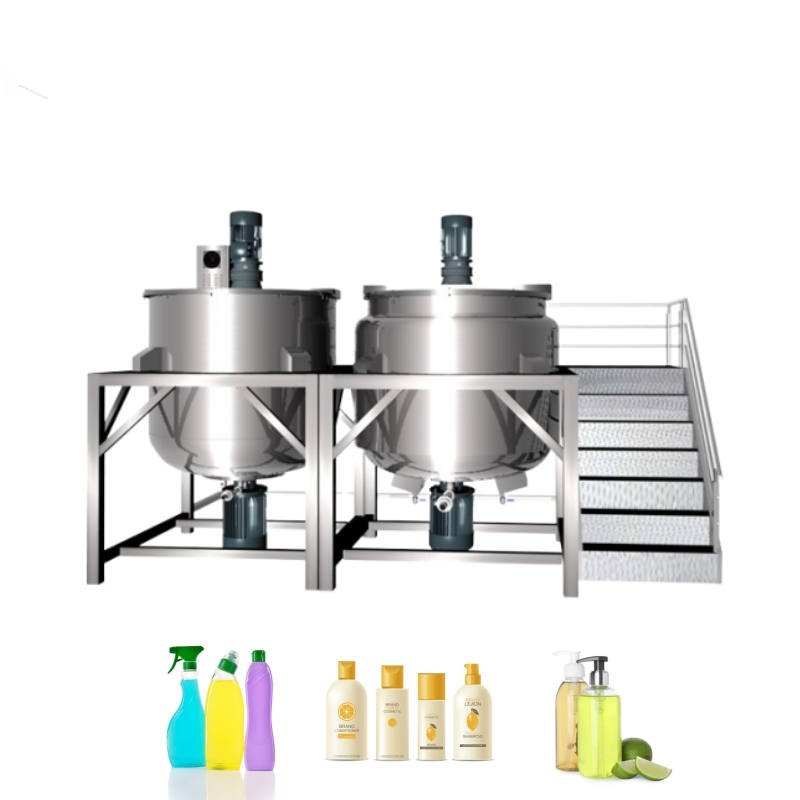
5. Cosmetics & Personal Care
Combined with high-shear units in dual-shaft vessels to manufacture thick body lotions, creams, shampoos, and toothpastes.
How to Choose an Industrial Agitator
Selecting the correct industrial agitator requires an understanding of both the product and the process.
1. Determine Tank Volume
Tank working volume is one of the first parameters required for agitator selection.
The total tank volume and actual working volume should both be considered.
2. Check Fluid Viscosity
Viscosity has a major influence on agitator selection.
Low-viscosity liquids can often be mixed using propeller or turbine impellers.
High-viscosity products may require anchor, helical, or other large-diameter impellers.
3. Consider Fluid Density
Fluid density affects the power required to rotate the impeller.
If solid particles are present, the density and concentration of the solid phase should also be considered.
4. Determine the Mixing Objective
The Industrial agitator should be selected based on the actual process objective.
For example:
- Liquid blending requires circulation.
- Solid suspension requires sufficient bottom circulation.
- Heat transfer requires good wall-side movement.
- Gas dispersion may require radial flow and higher turbulence.
- Emulsification requires high shear.
5. Select the Appropriate Impeller
Impeller selection should consider viscosity, tank geometry, required flow pattern, and mixing objective.
There is no single impeller that is suitable for every industrial process.
6. Determine Industrial Agitator Speed
Industrial agitator speed affects flow, shear, power consumption, and mixing time.
Higher speed does not necessarily mean better mixing.
Excessive speed can increase energy consumption, create unwanted foam, damage shear-sensitive products, or cause excessive turbulence.
7. Calculate Motor Power
Motor power should be selected according to the required mixing duty.
Important factors include:
- Fluid viscosity
- Density
- Impeller diameter
- Rotational speed
- Number of impellers
- Solid concentration
- Required mixing intensity
A properly sized motor should provide sufficient power without unnecessary oversizing.
NEWAFLUIDS Industrial Agitator
| Voltage | 100V/110V/ 220V/ 240V/ 380V/ 415V |
|---|---|
| Power | 0.37KW/0.55KW/0.75KW/1.1KW/1.5KW/2.2KW/3KW/4KW/5.5KW/7KW/11KW |
| Frequency | 50HZ/ 60HZ |
| Phrase | signal phrase/ three phrase |
| Leaf type | three leaf; – shape; three blade high efficiency type; custom made |
| Speed | 25/60/88/130/270//450 rpm |
| Shaft | 304/316 stainless steel or plastic lining(PO,PE,PTFE or Epoxy coating etc.) |
| Shaft length | 0.55m/1m/1.5m/2m-3.5m custom made accordingly |
| Shaft thick | 16mm, 25mm, 38mm, 57mm, 76mm…. |
| Custom made | Custom made shaft type, length, blade, specification like explosionproof motor |
Conclusion
An industrial agitator is an essential piece of equipment for controlling fluid movement and achieving uniform mixing in industrial tanks. Its performance depends on the interaction between the motor, shaft, impeller, tank geometry, fluid properties, and operating conditions.
Different applications require different agitator designs. Propeller and turbine agitators are commonly used for lower-viscosity liquids, while anchor and helical agitators are more suitable for high-viscosity materials. High-shear agitators are used when intensive dispersion or emulsification is required.
The most important step is to select the agitator based on the actual process requirements, rather than choosing equipment only according to tank capacity or motor power.
For a reliable industrial agitator solution, provide the tank dimensions, working volume, product viscosity, density, temperature, solids concentration, required mixing time, and mixing objective. These parameters allow the agitator, impeller, shaft, motor, and gearbox to be properly designed for the application.