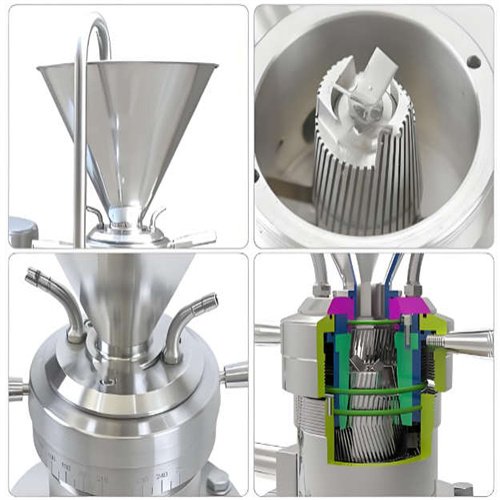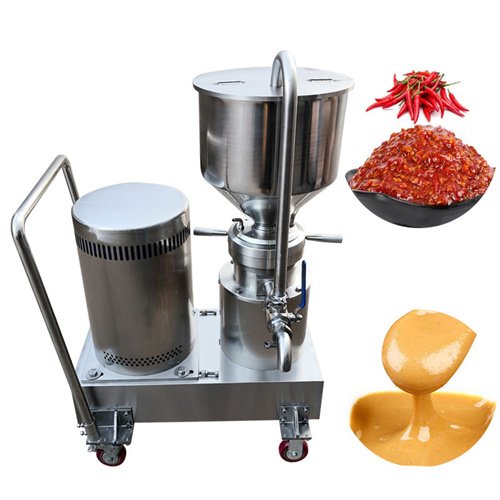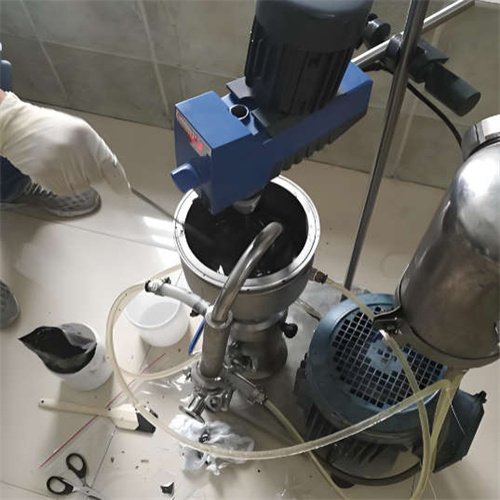
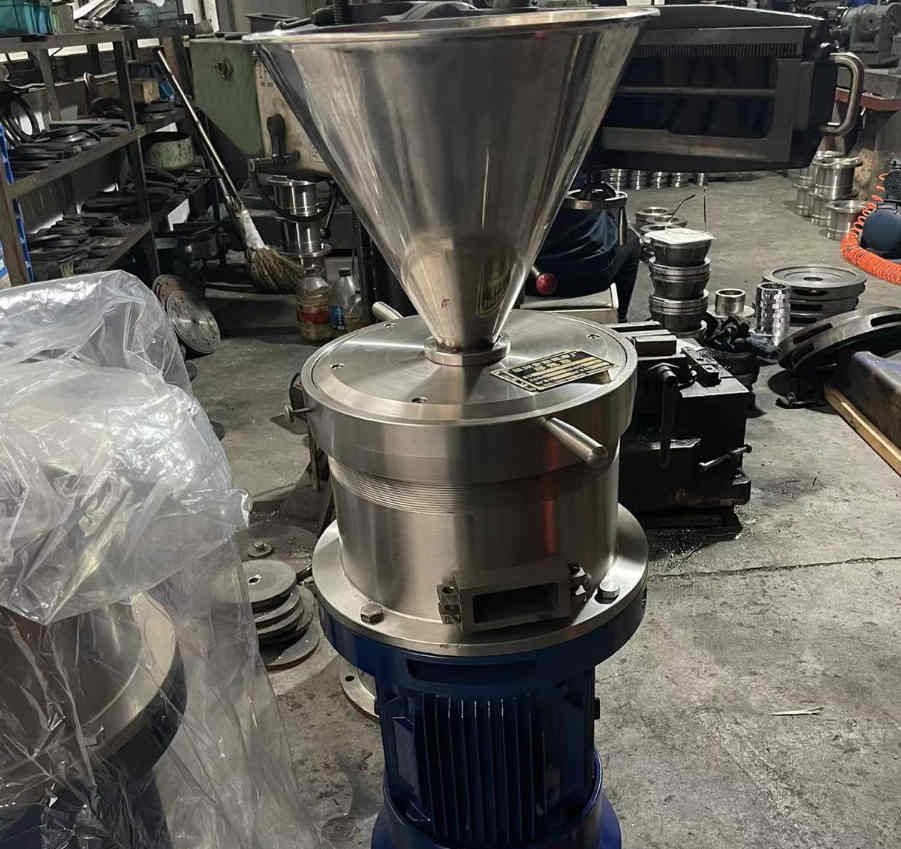
Colloid mill, as fine grinding equipment, is widely used in the food, chemical, and pharmaceutical industries. While highly efficient, these high-precision machines often face operational issues that disrupt production, reduce product quality, and increase maintenance costs.Their operational stability directly affects production efficiency. Below are common colloid mill issues and corresponding solutions to help quickly troubleshoot problems.
Inadequate Output Particle Size
One of the colloid mill issues is excessively large particles after grinding, failing to meet production requirements. The main causes are excessive clearance between the stator and rotor, or severe wear on the grinding surface.
Solution: First, stop the machine and disconnect the power. Then, precisely reduce the clearance using the adjustment handle, with a single adjustment not exceeding 0.05mm. If adjustment does not improve the situation, disassemble and inspect the grinding surface, and replace the worn stator or rotor.
Reduced Throughput (Low Output)
Second of the colloid mill issues is when the “liters per hour” drop significantly despite the motor running at full speed, efficiency is being lost.If air is being sucked into the inlet, it creates cavitation bubbles. This not only reduces the volume of product moved but can also pit and damage the stainless steel surfaces.
The Solution: Air-Tight Connections
- Seal the Inlet: Check all gaskets and Tri-Clamp fittings on the suction side for air leaks.
- Increase Head Pressure: If possible, place the supply tank higher than the mill to use gravity to help “prime” the unit.
Abnormal Equipment Vibration
Third of the colloid mill issues is the equipment vibrates violently during operation, accompanied by abnormal noises. This is often caused by uneven installation, loose anchor bolts, damaged bearings, or hard objects mixed in with the material.
Solution: Use a level to correct the equipment’s levelness and tighten the anchor bolts; disassemble the bearing components and replace any damaged bearings; check the feeding system and install a filter to prevent hard objects from entering the grinding chamber.
Severe Motor Overheating
Fourth of the colloid mill issues is the motor temperature rises rapidly, even triggering overheat protection. Causes include excessive load, cooling system blockage, and unstable power supply voltage.
Solutions: Reduce the feed rate to ensure uniform material feeding; clean the cooling water pipes or heat sinks to ensure smooth cooling; check the power supply voltage to ensure it is within the equipment’s rated voltage range.
Material Leakage
Fifth of the colloid mill issues is leakage, which is a frequent issue in colloid mills, often occurring at the mechanical seal, pipe connections, or grinding chamber. Root causes include: worn or damaged seals (mechanical or maze seals), loose pipe joints, damaged gaskets, or excessive pressure in the grinding chamber (exceeding 150 psi). Leakage not only wastes materials but also contaminates the equipment and workspace, especially in food and pharmaceutical industries
Solutions: First, reduce the grinding chamber pressure by opening the rotor-stator gap slightly. Inspect the mechanical seal—if it’s worn, misaligned, or damaged, replace it with an OEM part. For maze seals (common in some models), check for aging or damage and replace if needed. Tighten loose pipe joints and replace damaged gaskets. Ensure the seal flush water (if applicable) is properly plumbed and adjusted to 1/2–1 quart per minute to maintain seal integrity. For food/pharmaceutical applications, clean the leakage area thoroughly to prevent contamination.
Inconsistent Particle Size or “Gritty” Texture
The primary goal of a colloid mill is homogenization. If your final sauce, cream, or ointment feels uneven, the sixth of colloid mill issues is failing its core task.
The cause:Over time, abrasive materials (like sugar or chemical minerals) can erode the “teeth” of the rotor and stator. Furthermore, if the feed rate is too high, the material “short-circuits” the shear zone without being fully processed.
The Solution: Component Inspection and Metered Feeding
- Check for Erosion: Inspect the milling heads for rounded edges. If worn, the parts must be replaced or reground.
- Control the Flow: Use a Positive Displacement Pump to feed the mill at a consistent rate, ensuring every drop spends the necessary “residence time” in the shear zone.
Metal-to-Metal Contact
The Seventh of colloid mill issues is a catastrophic failure where the rotor and stator physically touch while spinning at 3,000+ RPM.This usually happens during manual adjustment if the operator “over-tightens” the gap while searching for a finer grind.
The Solution: Use the Limit Stop
- Calibrate the Zero-Point: Always identify the “touching point” while the machine is off. Set the mechanical limit stop so the adjustment handle cannot physically be turned into the “contact zone” during operation.
Comparison of Colloid Mill Issues Solution
| Issue | Immediate Action | Long-Term Prevention |
| Inadequate size | Stop the machine and disconnect the power | reduce the clearance |
| Low Output | Check all gaskets and Tri-Clamp fittings | place the supply tank higher than the mill |
| Vibration | Check mounting bolts | Quarterly bearing inspection |
| OverHeating | Increase cooling flow | Optimize gap settings |
| Leaking | Replace mechanical seal | Install a seal flush system |
| Gritty Texture | Reduce feed rate | Replace worn rotor/stator |
| Metal-to-Metal Contact | Identify the “touching point” | Use the Limit Stop |